Google Business Profile Advantages for Small Business 2026
A Google Business Profile gives small businesses free, verified visibility in Google Search and Maps, turning local searches into calls, direction requests, and website visits without spending a dollar on ads. In 2026, it’s doing even more than that, it’s become the primary way AI-powered search decides which businesses to recommend at all.
What Is a Google Business Profile?
A Google Business Profile, formerly called Google My Business, is a free listing that lets you control how your business shows up across Google Search, Google Maps, and Google Shopping. It holds your business name, address, phone number, hours, photos, services, and reviews and it’s the thing Google pulls from when someone searches your business name or a category like “coffee shop near me.”
Think of it less like a Yelp page and more like a digital storefront window. Anyone driving by (searching) can glance in, see what you offer, check if you’re open, read what other customers thought, and decide whether to walk in, all before they ever hit your actual website.
Two things make it different from a normal listing:
- It’s verified. Google confirms you actually operate the business at that location, which is part of why it carries so much trust with both customers and Google’s own ranking systems.
- It’s interactive. Customers can message you, ask questions, book appointments, or leave reviews directly from the listing, without leaving Google at all.
Top Google Business Profile Advantages for Small Business
Every advantage below ties back to one thing: Google trusts profiles that are complete, active, and genuinely useful to searchers and it rewards that trust with visibility.
Instant Local Visibility and Google Map Pack Rankings
The “local pack”- those three map listings that show up above the regular search results, captures roughly 44% of all local search clicks, according to NEWMEDIA.COM’s Google Business Profile statistics. Getting into that pack is, for most small businesses, worth more than ranking on page one of regular organic results, because it appears higher and includes your phone number, directions, and reviews right there in the results.
Google Business Profiles now show up in about 87% of local-intent searches that include map results, and Local 3-Pack listings appear for 93% of local intent queries overall, according to BizIQ’s 2026 report. If your profile isn’t optimized, you’re not just losing a ranking spot, you’re losing the entire discovery moment.
AI-Driven Search Rankings and Local SEO Ranking Signals
This is the part that’s shifted the most heading into 2026. AI Overviews now appear in roughly 40% of local business searches, per SeoProfy’s local SEO statistics roundup, which means Google is increasingly answering the question directly instead of just listing links. Impressions per location have actually dropped by about 53.8% industry-wide as AI surfaces answers earlier in the search process, yet customer actions, calls, visits, direction requests, have held nearly steady, down only about 5%, according to Birdeye’s State of Google Business Profile 2026 report.
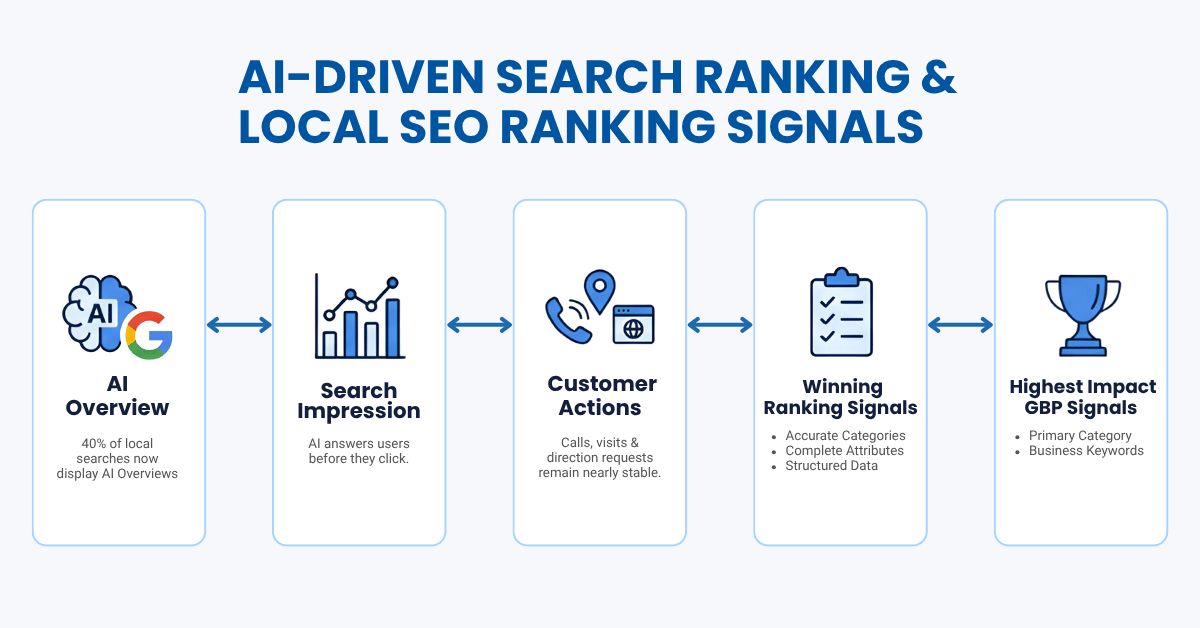
What that tells small business owners is important: fewer people are clicking through, but the ones who do are more qualified and more likely to act. The businesses winning in this environment are the ones with accurate categories, complete attributes, and structured data Google’s AI can confidently pull from. Primary category selection and keywords in the business title remain the two GBP signals with the single biggest impact on local pack rankings, per Whitespark’s local ranking factor survey, covered by SearchEndurance.
Direct Customer Interactions Through Messaging and Q&A
Businesses that enable messaging on their Google Business Profile receive 35% more leads than those that don’t, according to SQ Magazine’s Google Business Profile statistics. That’s a meaningful number for a feature that costs nothing and takes a few minutes to turn on.
Mobile searchers are also 2.3 times more likely to call a business directly through their Google Business Profile than desktop users, per SQ Magazine’s data, which makes sense, someone searching “electrician near me” on their phone at 8 PM on a Saturday isn’t planning to fill out a contact form. They want to tap a number and talk to a person.
Interestingly, 42% of all GBP conversions now happen without the customer ever visiting the business’s actual website, according to SQ Magazine. For a lot of small businesses, the profile itself has quietly become the primary sales channel, whether they’ve realized it or not.
Building Trust and Credibility Through Customer Reviews
Reviews aren’t just social proof anymore, they’re a documented ranking factor. Review signals contribute roughly 16% of what determines local pack rankings, per Digital Applied’s local SEO statistics, and businesses that land in the top three local search positions typically have more than 200 Google reviews, according to Localo’s data, covered by BloggingWizard.
Consumer behavior backs this up just as strongly. Ninety-eight percent of consumers read online reviews before choosing a local business, per BizIQ, and 47% of BrightLocal’s 2026 survey respondents said they simply won’t consider a business with fewer than 20 reviews, according to LocalHero’s coverage of that survey.
A few practical takeaways for small business owners:
- Respond to every review, good or bad, response length and consistency correlate with better rankings.
- Ask happy customers directly; most won’t leave a review unless prompted.
- Never buy or fake reviews. Google’s spam detection has gotten aggressive about flagging and removing them, and it can suspend your whole profile.
Free Marketing With Measurable Performance Insights
Unlike a billboard or a radio ad, a Google Business Profile tells you exactly what’s working. You can see how many people viewed your profile, requested directions, called, clicked to your website, or messaged you, broken down by week or month, with no third-party analytics tool required.
That data matters more than it sounds like. The average small or medium-sized business now receives roughly 1,009 searches per month through its Google Business Profile, split between around 228 direct searches (people searching your business name) and 781 discovery searches (people searching a category or need that led them to you), according to SQ Magazine’s benchmark data. That discovery number is the real prize, it’s brand-new customers finding you who’d never heard of you before.
Why Small Businesses Can’t Afford to Skip GBP in 2026
Some owners still treat their Google Business Profile as optional, something to “get to eventually.” That mindset is getting more expensive every year. Eighty-seven percent of consumers now use Google specifically to find local businesses, per a Statista survey covered by BloggingWizard, and 66% say they trust Google as their primary source of local business information, ahead of Google Maps, business websites, and Facebook, according to the same BloggingWizard breakdown.
There’s also a newer risk worth understanding: AI assistants like ChatGPT and Perplexity are starting to recommend local businesses too, and they lean heavily on the same underlying data. Only 68% of business information showing up on ChatGPT and Perplexity actually matches what’s listed on Google Business Profile, per the SOCi Local Visibility Index 2026, cited by BrightLocal. If your GBP data is outdated or incomplete, that inconsistency doesn’t just hurt you on Google, it’s now spreading into how AI tools describe your business to people who’ve never even used Google to find you.
Put simply: skipping GBP in 2026 doesn’t just mean missing out on Maps traffic. It means being functionally invisible across the tools an increasing share of consumers now use to make purchase decisions.
Google Business Profile vs. Having Your Own Website
This is one of the most common questions small business owners ask, and the honest answer is that it’s not really an either-or decision. Here’s how the two actually compare:
Factor | Google Business Profile | Business Website |
Cost | Free | Hosting, design, maintenance costs |
Setup time | Minutes to hours | Days to weeks |
Local search visibility | Very high, built into Maps/Search | Depends entirely on separate SEO work |
Customer trust signals | Reviews, verified badge, direct Q&A | Depends on design and content quality |
Depth of information | Limited fields, photos, posts | Full control, unlimited content |
Booking/e-commerce | Basic messaging, limited booking | Full checkout, custom booking flows |
Brand storytelling | Minimal | Full control over narrative and design |
A Google Business Profile gets you found fast and builds immediate local trust. A website gives you room to tell a fuller story, sell directly, and build long-term brand equity that isn’t dependent on a Google algorithm. Around 61% of verified Google Business Profiles now include a direct link to a business website, according to NEWMEDIA.COM — which tells you what the smartest businesses are already doing: using GBP as the front door and the website as the place customers go once they’re genuinely interested.
For a brand-new business on a tight budget, GBP alone can generate real leads immediately. But as the business grows, pairing it with a proper website becomes the difference between capturing a customer once and keeping them long-term.
How to Optimize Your Google Business Profile Fast in 2026
If you’re starting from scratch or fixing a neglected profile, here’s the order that actually moves the needle:
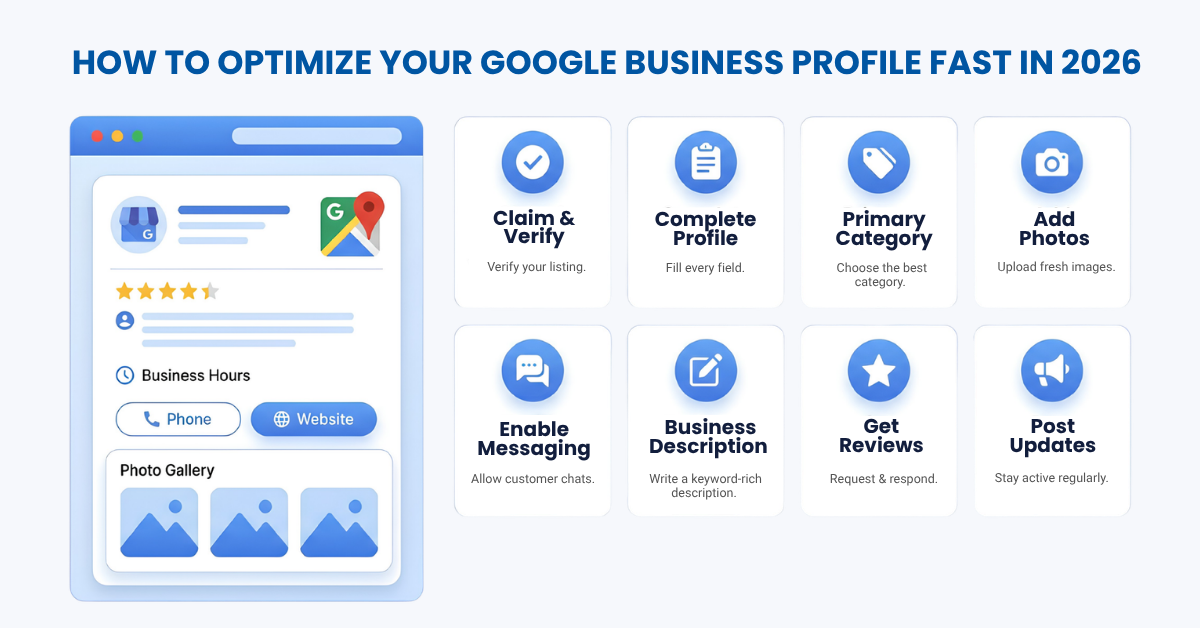
- Claim and verify your listing first. Nothing else matters until Google confirms you’re a real, legitimate business at that address.
- Fill out every field completely. Businesses with complete profiles get roughly 2.3 times more search visibility than incomplete ones, per BloggingWizard. Skip nothing, hours, categories, attributes, service areas.
- Pick your primary category carefully. It’s the single highest-weighted GBP ranking signal, so choose the most specific accurate option, not the broadest one.
- Add real, current photos regularly. Profiles with fresh photos get about 27% more discovery impressions than those with stale images..
- Turn on messaging. It’s a free feature directly tied to a 35% lead increase, as noted earlier.
- Write a real business description. Top-ranking businesses in the top three positions use close to 70 words in their description field, versus fewer than 50 words for lower-ranked competitors, per Localo’s data, covered by BloggingWizard.
- Ask for reviews consistently, and respond to all of them. This is an ongoing task, not a one-time setup step.
- Post updates regularly. About 34% of businesses have never posted a single update to their profile, which means simply posting consistently already puts you ahead of a third of your competition.
Common Google Business Profile Mistakes That Hurt Ranking
Most of the damage done to a Google Business Profile isn’t from anything dramatic, it’s from small neglect that adds up:
- Inconsistent NAP data. Businesses with mismatched name, address, or phone info across the web see about 18% lower local visibility than those with consistent data, per SeoProfy.
- Leaving out the business description. Nearly 29% of local business profiles still skip this field entirely, losing an easy ranking and trust opportunity.
- Outdated hours or contact details. About 39% of local profiles have outdated hours, phone numbers, or addresses, per NEWMEDIA.COM, a fast way to lose a customer who shows up to a closed door.
- Ignoring reviews. Silence on negative reviews reads as indifference to both customers and Google’s ranking algorithm.
- Choosing the wrong or an overly broad category. This single decision affects which searches you even have a chance of appearing in.
- Buying fake reviews or engagement. Google’s spam enforcement has tightened specifically around scaled, templated, or manipulated review activity, and profiles caught doing this risk suspension.
How BA3 Digital Marketing Helps Small Businesses Optimize GBP
This is the exact work BA3 Digital Marketing handles for local business clients, full Google Business Profile setup, category and attribute optimization, ongoing review generation and response management, regular photo and post updates, and performance tracking tied to actual calls, direction requests, and website clicks, not just vanity impressions.
Because BA3 also runs local SEO, content marketing, and web development under one roof, a Google Business Profile isn’t treated as an isolated task. It’s built into a broader local visibility strategy, one that connects your Maps presence, your website, and your on-page SEO so all three reinforce each other instead of competing for the same customer search.
Conclusion
Google Business Profile isn’t a nice-to-have anymore, it’s become one of the highest-leverage, lowest-cost tools available to any small business, and the data backs that up at every level: visibility, trust, conversions, and now even AI search recommendations. The businesses winning local search in 2026 aren’t necessarily the biggest ones. They’re the ones who claimed their profile, filled it out completely, and kept it active.
If your profile has been sitting untouched, incomplete, or unclaimed, that’s the single fastest fix available to your business this quarter and unlike most marketing investments, it starts paying off the moment you finish it.
Frequently Asked Questions
What is Google Business Profile and why is it important for small businesses in 2026?
Google Business Profile is your free listing on Google Search and Maps. In 2026, it is one of the most important tools for small businesses because most local customers search on Google first before calling or visiting.
How does Google Business Profile help small businesses get more customers?
It helps you appear in the Google Map Pack, build trust through reviews, and make it easy for customers to call or get directions. Many small businesses see more calls and visits after optimizing their profile.
How long does it take to see results from Google Business Profile optimization?
Most small businesses start seeing more views and calls within 2 to 4 weeks. Significant improvement in Map Pack ranking usually takes 1 to 3 months of consistent optimization.
Can small businesses in small towns benefit from Google Business Profile?
Absolutely. In smaller towns and cities, competition is often lower, so a well-optimized profile can help you dominate local search results quickly.
What is the biggest mistake small businesses make with Google Business Profile?
The most common mistake is leaving the profile incomplete or outdated. Incomplete profiles rank much lower and lose potential customers to competitors.
How can BA3 Digital Marketing help small businesses with Google Business Profile?
We help small businesses set up, optimize, and maintain their Google Business Profile for better local visibility. From verification to review management and regular updates, we handle everything so you can focus on running your business.