How to Improve Brand Visibility in AI Search Engines
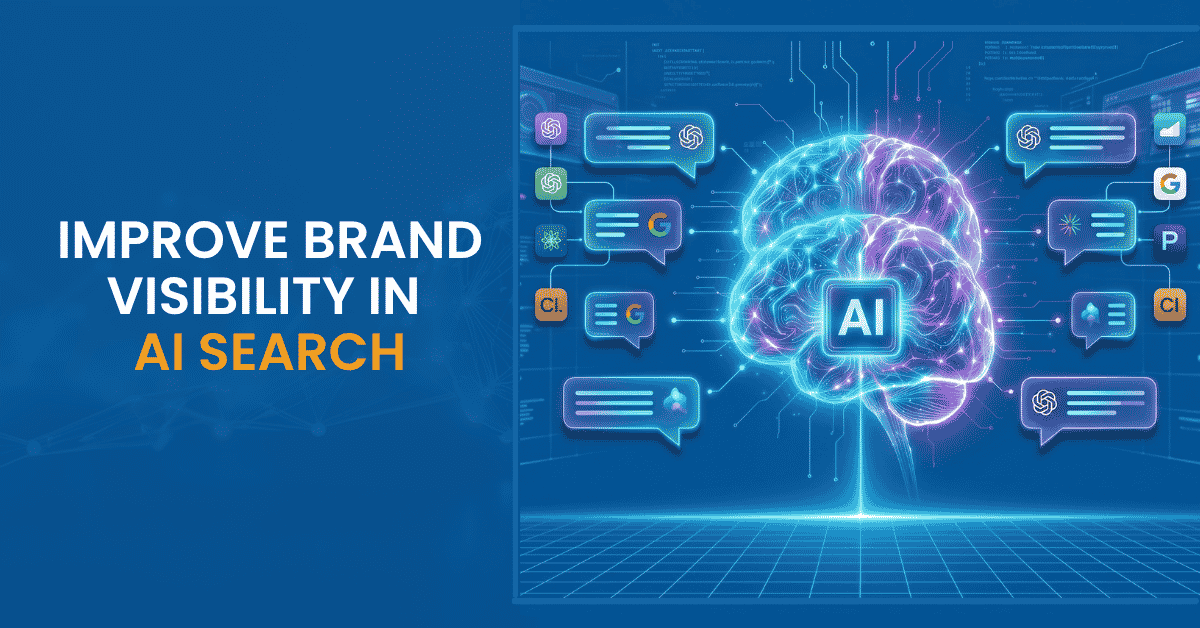
Brand visibility in AI search engines comes down to one thing, how AI systems like ChatGPT, Perplexity, and Gemini actually find and recommend brands, which is fundamentally different from traditional SEO. AI engines don’t rank pages. They build answers from patterns they’ve seen across the web, and the brands they recommend are the ones with the clearest, most consistent, most widely mentioned presence across multiple sources.
The shift is already underway. 93% of AI search sessions end without a website click, meaning if your brand isn’t mentioned inside the AI response itself, you may not exist for that user at all (Superlines, 2026). That’s not a future problem. It’s happening right now.
This guide walks through exactly what to do, in a clear, practical order.
What Is AI Search and Why Brand Visibility Matters Now
AI search refers to platforms like ChatGPT, Google Gemini, Perplexity, and Claude that give users a single, synthesized answer instead of a list of links. Instead of ten blue links, the user gets one recommendation, one business name, one product, one answer.
ChatGPT alone processes 250 to 500 million search-intent queries per week and has grown into one of the top five search properties globally (DocDigitalSEM, 2026). Gemini grew 157% between April and September 2025. Perplexity reached 170 million monthly visits. The audience has shifted and it shifted fast.
Here’s why this matters so directly for brand visibility: traditional search gave you ten spots on a page. AI search gives you one answer. Only 11% of cited domains appear across multiple AI platforms, meaning most brands are invisible on at least some of the platforms their customers are using (DocDigitalSEM, 2026).
The brands winning in AI search right now share a common characteristic: they’re everywhere. Not just on their own website but across third-party publications, review platforms, community forums, and structured content that AI systems can easily read and trust.
Optimize Your Content for Conversational AI Queries
AI engines prefer content that directly answers questions. Not content that hints at an answer three paragraphs in content where the answer is in the first two sentences, clearly stated, and written the way a person would actually ask the question.
This approach is called Answer Engine Optimization (AEO), and it’s the 2026 evolution of featured snippet optimization.
Practical steps to optimize for conversational queries:
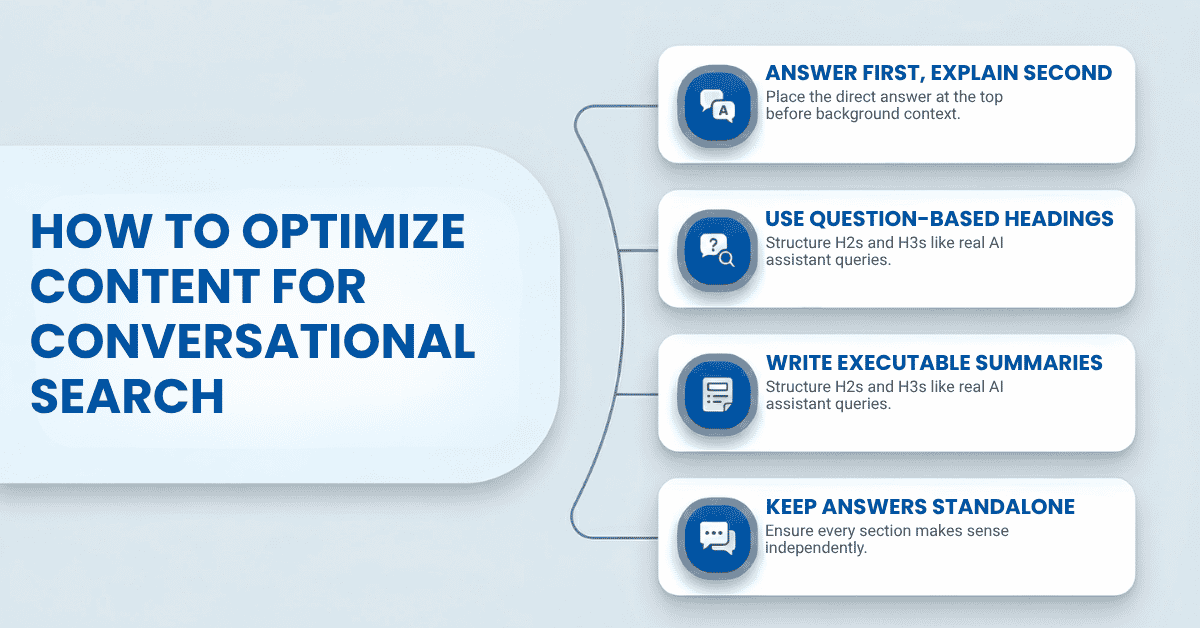
- Answer first, explain second: put the direct answer at the top of every section before any background context
- Use question-based headings: name your H2s and H3s exactly the way someone would ask an AI assistant. “What is X” and “How do I Y” headings match conversational query patterns
- Write executable summaries: place a clear bulleted summary at the top of key blog posts and articles. AI models extract and reuse these directly
- Keep answers standalone: each section should make sense on its own without requiring the reader to have read everything above it. AI systems pull sections in isolation
Content with statistics, citations, and quotations achieves 30–40% higher visibility in AI responses, and pages updated within two months earn 28% more citations than older content (Superlines, 2026). Freshness and specificity are both signals AI systems use when deciding what to surface.
Build Third-Party Validation AI Engines Trust Most
AI systems don’t just evaluate what you say about yourself. They evaluate what the rest of the internet says about you. A brand that appears only on its own website looks like a single source. A brand that appears consistently across publishers, review platforms, and community forums looks like a consensus and consensus is what AI systems are designed to surface.
Reddit is the #1 cited source across every major AI engine, cited at roughly 40% frequency across LLMs (5WPR AI Citation Source Index, 2026). If your brand has no presence in relevant Reddit threads, you’re invisible in Perplexity, which pulls 46.7% of its top-10 citations from Reddit.
Where to build third-party validation:
- Review platforms: Google Business Profile, Trustpilot, G2, Capterra. The average rating of companies recommended by ChatGPT is 4.3 stars. Companies below the average were often omitted entirely (Trustmary, 2026)
- Industry publications and roundups : being featured in “best of” articles and comparison guides gives AI systems the external consensus they’re looking for
- Reddit and Quora: genuine, helpful participation in relevant threads generates 4–7x more citations than passive presence (ConvertMate, 2026)
- Wikipedia mentions: Wikipedia accounts for 26–48% of ChatGPT’s top-10 citation share. Even an indirect mention on a relevant Wikipedia page matters
- Digital PR and news coverage: web mentions frequency is the single most important factor for AI citations, with a 0.664 correlation in ConvertMate’s analysis of 80 million citations (ConvertMate, 2026)
Establish Deep Topical Authority in Your Niche
Scattered content on many topics signals a generalist site. Deep, comprehensive coverage of a specific subject signals authority and AI systems heavily weight authoritative sources when building their answers.
The shift from broad content to topical depth isn’t just an SEO best practice anymore. It’s how you become the source AI systems treat as the default answer for your category.
How to build topical authority:
- Build pillar pages: Develop one comprehensive, definitive guide for each core topic your business covers. This becomes the anchor that all other supporting content points back to.
- Answer long-tail questions deeply: write supporting articles that address narrow, specific pain points within your niche. The more specific the question you answer, the more likely an AI system cites you for it.
- Add multimodal content: AI systems are increasingly indexing video, infographics, and structured visual content. Embedding relevant videos, charts, and visual summaries within written content improves citation probability
- Update content on a 30-day cycle: pages updated within 2 months earn 28% more AI citations than older content (Superlines, 2026). A content refresh calendar isn’t optional, it’s an AI visibility strategy.
Use Schema Markup So AI Can Read Your Content Easily
Schema markup is structured data you add to your pages that tells AI systems exactly what your content is- a product, an FAQ, a how-to guide, a review, a business. Without it, AI has to guess. With it, the content is immediately categorized and prioritized.
Implementing comprehensive schema markup improves AI visibility by 67%, according to ConvertMate’s analysis of 10,000+ domains (ConvertMate, 2026). That’s not a minor technical improvement, that’s one of the highest-ROI changes you can make.
Schema types that matter most for AI visibility:
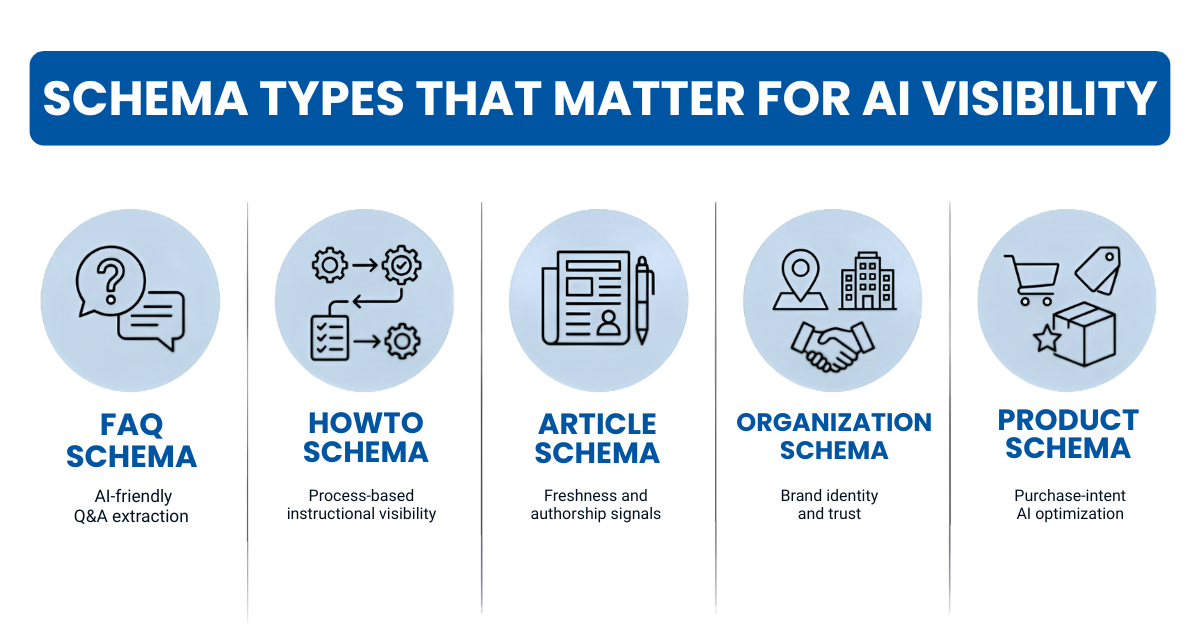
- FAQ schema: marks up your question-and-answer sections so AI systems can extract them directly
- HowTo schema: signals step-by-step instructional content, which AI systems prioritize for process-based queries
- Article schema: confirms authorship, publish date, and update date, supporting the freshness signals AI engines use
- Organization and LocalBusiness schema: tells AI systems exactly who you are, what you do, and where you operate
- Product schema: critical for e-commerce brands wanting to appear in purchase-intent AI queries
Add all schema in JSON-LD format. It’s cleaner, easier for crawlers to parse, and the format Google explicitly recommends.
Build a Strong Brand Footprint Across Multiple Platforms
AI visibility isn’t a one-platform game. Citation rates, sentiment and brand mention patterns vary up to 615x across AI platforms (Superlines, 2026). A brand succeeding on ChatGPT could be all but invisible on Perplexity. It is an expensive mistake to build visibility on one platform and assume that it carries over everywhere.
Where to build your multi-platform footprint:
- Social platforms: consistent presence on LinkedIn, YouTube, and Instagram creates the cross-platform mention patterns AI systems use to build brand recognition.
- Industry directories and aggregators: platforms like Clutch, G2, Capterra, and Trustpilot generate authoritative third-party citations that AI systems trust.
- Guest content and contributed articles: Being published in reputable industry publications is a great way to earn backlinks and citations from domains that AI systems already trust a lot. .
- YouTube specifically: YouTube content is included in Google AI Overviews and is indexed by most AI systems as a legitimate , authoritative source . Video content is no longer optional if you want your AI to be seen.
Users referred from ChatGPT spend an average of 15 minutes on site versus 8 minutes for Google referrals, and convert to transactional sites at a 7% rate versus 5% from Google (Similarweb, 2026). The volume of AI referral traffic is lower, but the quality is measurably higher.
Why Consistent Brand Messaging Wins AI Search in 2026
AI systems are pattern-recognition machines. They build their understanding of your brand from every mention, description, and association they’ve seen across the web. If your brand is described differently on every platform, different positioning, different tone, different core message, AI systems struggle to build a coherent picture of who you are. The result is inconsistent or absent recommendations.
Consistent brand messaging across every channel you operate isn’t just a marketing best practice. It’s how AI systems learn to recognize you as the authoritative answer for your category.
What consistency looks like in practice:
- The same core value proposition on your website, LinkedIn, Google Business Profile and 3rd party listings.
- Identical brand voice and positioning in guest articles, press releases and social media.
- The same key word associations show up in all of your content . AI systems assign weight to terms that appear consistently across multiple sources .
- Accurate, current business information on every directory and platform where your brand appears.
Brand search volume has a 0.334 correlation with AI citations making it the second strongest predictor of AI visibility after web mentions frequency (ConvertMate, 2026). When people search for your brand by name, that signal tells AI systems you’re a recognized entity worth recommending.
How to Track Your Brand Visibility in AI Search Engines
Traditional rank trackers show where you appear in Google’s blue links. They show nothing about how your brand is represented in ChatGPT, Perplexity, or Gemini. Tracking AI visibility requires a different set of tools and a different set of metrics.
What to measure:
- Mention frequency: how often your brand appears in AI responses for target queries across each platform
- Sentiment: when your brand is mentioned, is it recommended positively, neutrally, or not at all? The average sentiment gap between Perplexity (76.9% positive) and ChatGPT (5.2% positive) for the same brands is 14.8x (Superlines, 2026)
- Citation vs. mention ratio: some platforms name your brand without linking to it. Both matter, but they serve different purposes
- Share of model: how your brand mention frequency compares to competitors for the same query category
Tools for AI visibility tracking:
- Semrush One: tracks brand mentions across AI platforms alongside traditional SEO data
- Profound: connects AI citations to conversion data to show which AI-referred visitors actually become customers
- Evertune: monitors brand mentions and sentiment across LLMs
- Manual prompt testing: query ChatGPT, Perplexity, and Gemini regularly with your target keywords and document how your brand appears, where it’s positioned, and how it’s described
Set a consistent testing schedule, weekly for competitive categories, bi-weekly for slower-moving niches. AI responses change, and what showed your brand last month may look different this month.
How BA3 Digital Marketing Helps Your Brand Win AI Search
Most businesses understand that AI search visibility matters but the work required to build it is spread across content strategy, technical SEO, schema implementation, digital PR, review management, and multi-platform consistency. That’s a lot to manage when you’re already running a business.
BA3 Digital Marketing helps brands build the kind of digital presence AI systems recognize, trust, and recommend. The service covers the full picture:
- Content optimization for AEO: restructuring existing content and creating new content that answers conversational queries directly, with proper schema markup throughout
- Third-party validation building: identifying and executing the digital PR, review, and community strategies that generate the external citations AI systems weight most heavily
- Brand footprint development: building consistent, authoritative presence across the platforms and directories that feed into AI citation networks
- AI visibility tracking: monitoring how your brand appears across ChatGPT, Perplexity, and Gemini, with clear reporting on what’s working and what isn’t
- Video content for AI indexing: creating and optimizing video content that appears in AI Overviews and builds topical authority through multimodal formats
If your brand isn’t showing up when your customers ask AI tools for recommendations in your category, that’s a solvable problem and the businesses solving it now are building a head start that compounds over the next two to three years. Visit ba3digitalmarketing.com.bd to start the conversation.
Conclusion
AI search is not replacing traditional SEO. It’s adding an entirely new layer of visibility that most businesses aren’t optimizing for yet. The brands winning in this environment aren’t necessarily the ones with the highest domain authority, they’re the ones with the most consistent, most widely distributed, most clearly structured presence across the web.
The steps are clear: answer questions directly, build external validation, establish topical depth, implement schema markup, maintain consistent messaging, distribute across platforms, and track what AI systems are saying about you. None of it is complicated. All of it compounds over time.
The brands that start now will be the ones AI systems recommend six months from now. The ones that wait will spend that six months watching competitors get recommended instead.
Frequently Asked Questions
What is brand visibility in AI search engines?
Brand visibility in AI search means how often and how prominently your brand appears when someone asks ChatGPT, Gemini, Perplexity, or Claude a question related to your product or service. Unlike traditional search, there is no page two. AI gives one answer and if your brand isn’t in it, you’re invisible to that user.
Why is AI search visibility different from traditional SEO?
Traditional SEO focuses on ranking pages in Google. AI search visibility focuses on being mentioned inside AI-generated answers. AI systems don’t rank links, they build responses from patterns across the web. The brands they recommend are the ones with the clearest, most consistent, and most widely mentioned presence across multiple sources.
How does AI decide which brands to recommend?
AI systems look for brands that appear consistently across multiple trusted sources, review platforms, publications, forums, and directories. Web mention frequency has a 0.664 correlation with AI citations, making it the strongest predictor of whether AI recommends your brand.
How many AI search platforms should a brand optimize for?
All of them-ChatGPT, Gemini, Perplexity, and Claude at minimum. Citation rates and brand mention patterns vary up to 615x across platforms. A brand winning on ChatGPT can be nearly invisible on Perplexity. Optimizing for one platform and assuming it carries over everywhere is a costly mistake.
How long does it take to improve brand visibility in AI search?
Most brands see measurable improvement within 60 to 90 days of consistent effort, publishing fresh content, building third-party citations, and implementing schema markup. Building deep topical authority and a strong multi-platform footprint takes 3 to 6 months to compound meaningfully.
How can BA3 Digital Marketing help improve my brand's AI search visibility?
BA3 Digital Marketing handles the full picture. Content optimization for AEO, schema markup implementation, digital PR for third-party citations, multi-platform brand footprint building, and AI visibility tracking. If your brand isn’t showing up when customers ask AI tools for recommendations in your category, visit BA3 Digital Marketing to start the conversation.